How a concertina or scissor ladder folds
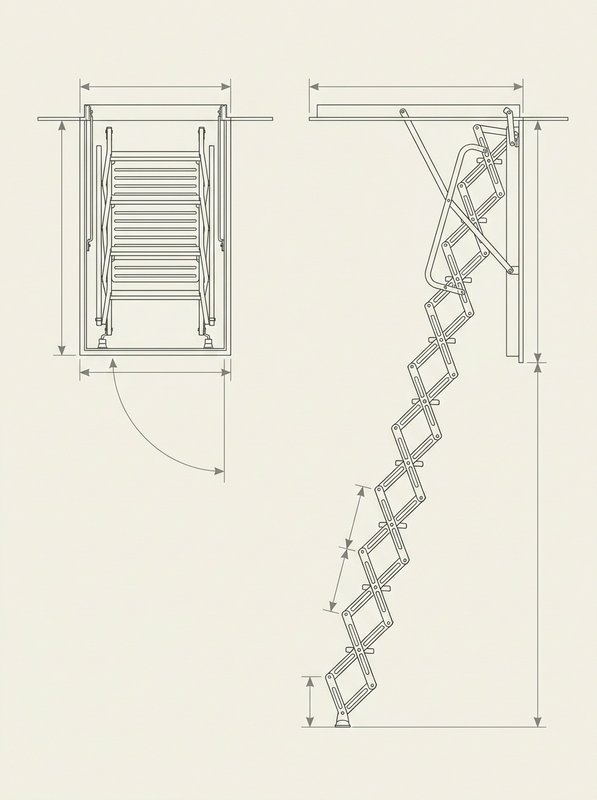
A concertina or scissor ladder folds the way a lazy-tongs toy does: a frame of crossed, hinged arms that collapses flat against the hatch when it's not in use and pulls open into a run of steps when it is. There's no separate box of folded timber sections and no track running down the wall, just the one hinged frame doing both jobs.
That folding action is why these ladders ask for less room than most other types, both at the opening above and on the landing below.
- Fakro's LST scissor ladder fits openings from 50 x 80 cm and needs a swing clearance, the length of landing it needs to open fully, of 140 to 170 cm. As standard it's built for floor-to-ceiling heights of 250 to 280 cm; Fakro calls this room height, and it's the same measurement.
- TB Davies's MiniFold concertina ladder needs a 900 x 700 mm opening and suits floor-to-floor heights from 2.25 m to 3 m.
Among the makers' published figures, this folding mechanism also carries more weight than the folding timber and sliding types do. What that load rating actually covers, and how to check it against what you weigh plus what you'll be carrying up, is set out on the loft ladder weight limits page. If you haven't got your own five measurements to hand yet, the guide to measuring for a loft ladder covers where each one is taken from.
What a concertina ladder costs you in climb comfort and storage height
Every loft ladder folds away somehow, and the mechanism it uses decides what you get back once you're standing on it and once it's put away. A concertina ladder, also called a scissor ladder, closes like a lazy-tongs toy: the frame collapses into a stack of diamond-shaped sections that stretch open when you pull the ladder down. That mechanism is what lets it live in such a small hatch and landing, and it also changes how the climb feels underfoot and how much room the folded ladder takes up once you've finished with it.
Climb comfort
A folding timber ladder gives you a run of flat, full-width treads at a shallow, stair-like angle, because each section is built as one rigid piece of timber. A concertina ladder's treads are set into the lazy-tongs frame itself, so they tend to be narrower and spaced more steeply, and the ladder often sits closer to vertical than a timber one does. Climbing it feels more like climbing a ladder than climbing a stair.
Storage height
When a folding timber ladder closes, its sections fold flat against each other and sit close to the hatch. A concertina ladder collapses upward instead, so the folded stack needs headroom above the hatch to retract into, and the fitted unit can sit proud of the ceiling by more than a timber ladder's folded sections do.
If your ceiling height is already tight, that headroom above the hatch is worth checking before you settle on a concertina ladder. You can work out what you're measuring against on the page on measuring for a loft ladder.